A BaZi chart is read in layers. Calculation establishes the facts; symbolism supplies the language; the real question gives the reading its focus.
How to read a BaZi chart: quick answer
To read a BaZi chart, verify the birth date, time and time zone first. Identify the Day Master, read the month branch for seasonal context, check roots and hidden stems, then map the Ten Gods and Earthly Branch interactions. The hour pillar adds detail about timing and private patterns only after the birth data has been checked.
The goal is not to turn one symbol into a fixed prediction. Read the chart in layers and compare the symbolic pattern with the person’s actual experience.
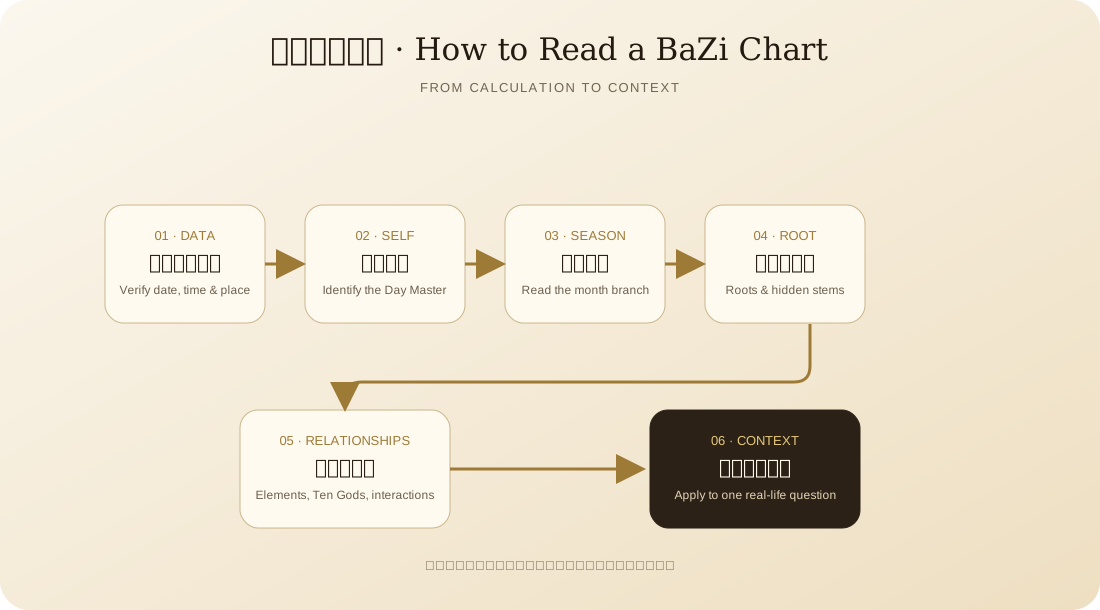
The recommended reading order
- Verify the birth date, time, time zone and birthplace.
- Identify the Day Master and its yin-yang polarity.
- Read the month branch and seasonal environment.
- Check roots, hidden stems and support.
- Map the Ten Gods and the relationships between elements.
- Review branch combinations, clashes, punishments and harms.
- Connect the structure to one concrete question.
1. Verify the birth data
BaZi months follow solar terms rather than the ordinary calendar month. The year pillar is also traditionally linked to the Beginning of Spring rather than January 1.
Birth time affects the hour pillar, while birthplace may affect true solar time. If the hour is unknown, the responsible choice is to analyze three pillars and state the limitation rather than invent an hour.
2. Find the Day Master
The Day Master is the Heavenly Stem of the Day Pillar. It is the reference point for interpreting support, output, wealth, pressure and resources.
A Jia Wood and Yi Wood person both have a Wood Day Master, but yin and yang are not simple “strong” and “weak” labels. They describe different styles of expression.
Hour pillar and birth time: what changes?
The Hour Pillar is the fourth pillar in a Four Pillars chart. It combines the Heavenly Stem and Earthly Branch assigned to the birth hour. Traditional systems divide the day into twelve two-hour segments, although different schools handle exact boundaries and the Zi-hour day transition differently.
Use an exact local birth time and verify the time zone before relying on the hour pillar. Some practitioners also adjust for true solar time based on birthplace and longitude. A calculator should state which convention it uses so the result can be checked consistently.
The hour pillar does not replace the Day Master or seasonal analysis. It adds a further layer that may contextualise private tendencies, later-life patterns or the way a chart is expressed. Treat those links as symbolic hypotheses rather than fixed promises.
For the role of all four pillars, read What Is BaZi?. When the core details are ready, you can create a free Four Pillars chart and compare the calculated hour with the recorded birth time.
3. Read the month branch before counting elements
The month branch describes the seasonal environment. Wood is typically associated with spring, Fire with summer, Metal with autumn and Water with winter. Earth is emphasized at seasonal transitions in many frameworks.
An element can be frequent yet poorly placed, or scarce but strongly supported. Season changes how the whole chart behaves.
4. Check roots and hidden stems
A visible Heavenly Stem needs support. Rooting occurs when a matching or related element appears inside an Earthly Branch, including hidden stems.
This is why a chart can be described as having “Wood on the surface” while the real support of the Wood is stronger or weaker than the visible count suggests.
5. Map the Ten Gods
The Ten Gods categorize relationships to the Day Master: Companion, Rival, Eating God, Hurting Officer, Direct and Indirect Wealth, Direct Officer, Seven Killings, Direct and Indirect Resource.
These names are functions, not guarantees. Wealth can describe the way effort becomes value; Officer can describe rules and responsibility; Resource can describe learning and support. None of them independently proves money, marriage or status.
Read the related Ten Gods guide for the full relationship map.
6. Review Earthly Branch interactions
Branches can combine, clash, punish or harm. These relationships may support or constrain the elements inside them.
Do not interpret a clash as automatic bad news. A clash can describe movement, disruption or a change in emphasis. Its meaning depends on the season, the affected elements and the question.
7. Connect the chart to one real question
“What is my destiny?” is too broad for a useful reading. A better question is specific: “Which work style supports sustained focus?” or “What relationship pattern do I tend to repeat?”
A focused question keeps the interpretation accountable to actual experience. The chart should generate hypotheses to compare with reality, not overwrite reality.
Read your chart in the right order
Start with the Four Pillars, Day Master, month branch, hidden stems and Ten Gods in one free chart.
Frequently asked questions
What should I look at first in a BaZi chart?
First verify the data, then identify the Day Master and month branch. Seasonal context comes before counting visible elements.
Why are hidden stems important?
They can reveal roots and supporting elements inside the branches, changing the effective strength of a visible stem.
Are Ten Gods literal predictions?
No. They are relationship categories. Wealth and Officer names do not guarantee money, promotion or a specific partner.
Why can the same chart produce different readings?
Schools weigh season, hidden stems and interactions differently. A responsible reading states its assumptions and avoids treating a symbol as certainty.
How do I find my BaZi hour pillar?
The hour pillar combines the Heavenly Stem and Earthly Branch assigned to the birth hour. Confirm the clock time and time zone, and check whether the calculator adjusts for true solar time or a school-specific day-boundary rule.
Does birth time change a BaZi chart?
Yes. The birth time determines the hour pillar, while time zone and day-boundary conventions can also affect the calculation. If the time is unknown, a responsible reading should analyze the available pillars and state the limitation.
Disclaimer: This guide is educational and cultural content. It is not a scientifically validated method for predicting future events and does not replace professional advice.