A BaZi chart is not a shopping list of five ingredients. It is a structured network. Every element can be strengthened by one phase, drained by another, controlled by a third and asked to control a fourth.
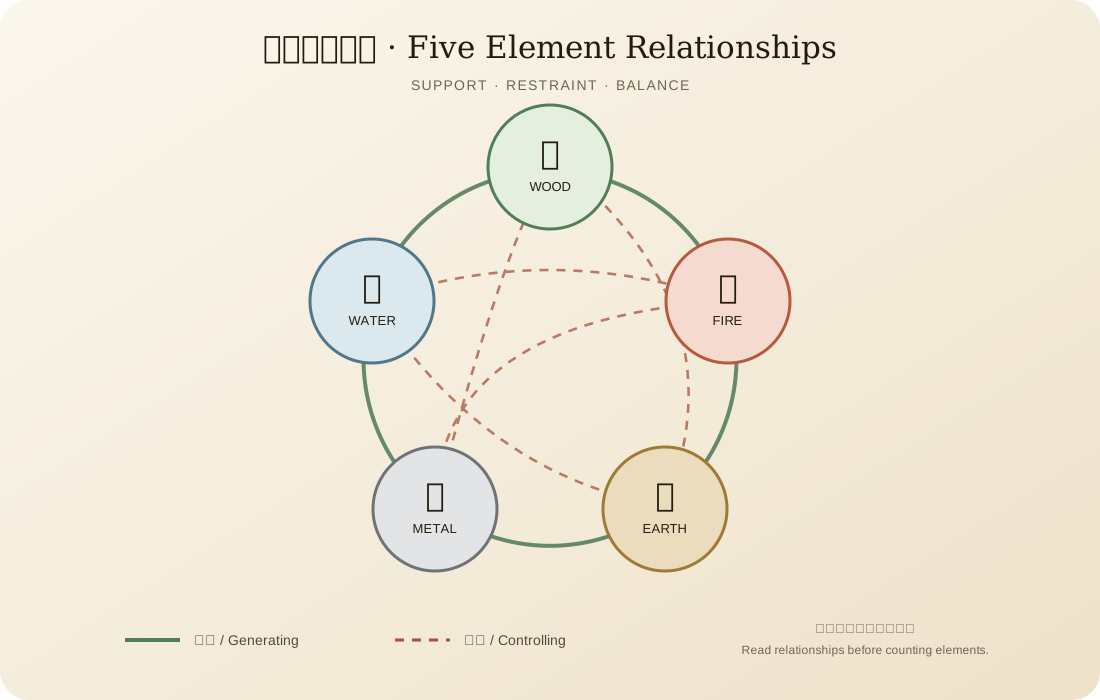
Relationships come before labels
In traditional Chinese thought, Wu Xing describes five movements or phases: Wood, Fire, Earth, Metal and Water. They are processes rather than literal substances.
Within a BaZi chart, the important question is not simply “How much Metal is present?” A more useful question is “Is this Metal supported by its season, rooted in the branches, exposed at the stems, drained by Water or pressured by Fire?”
The generating cycle: Sheng
The standard generating sequence is:
- Wood feeds Fire: growth becomes visible expression.
- Fire forms Earth: activity settles into stability.
- Earth contains Metal: form and boundaries develop inside structure.
- Metal enriches Water: refinement supports flow and reflection.
- Water nourishes Wood: flow supplies growth.
This relationship is often called the “mother-child” cycle. The producing element supports the produced element. But generation is not automatically beneficial. Too much Water can drown young Wood; too much Wood can overwhelm Fire; too much Earth can bury Metal.
Draining: the same relationship seen from the source
Every generating relationship also drains the source. Wood is drained by Fire. Fire is drained by Earth. Earth is drained by Metal. Metal is drained by Water. Water is drained by Wood.
Draining is not inherently bad. It is how energy becomes expression, output and productivity. A strong element often needs a healthy outlet. A weak element, however, may become tired when it produces too much without support.
This distinction matters in practical readings. “Output” can mean creativity, communication or action, but it can also mean overgiving, overwork or spending more energy than the chart can recover.
The controlling cycle: Ke
The standard controlling sequence is:
- Wood controls Earth: roots shape the ground.
- Earth controls Water: banks give water direction.
- Water controls Fire: flow limits heat.
- Fire controls Metal: heat refines raw material.
- Metal controls Wood: an edge shapes growth.
Control is often translated with negative language, but a chart needs boundaries. Rules, deadlines and discernment can protect a relationship or project. The question is whether the control is proportionate.
Overcontrol and counteraction
Traditional texts distinguish ordinary control from excessive control, often called Xiang Cheng. For example, abundant Wood can overburden weak Earth. Abundant Metal can become excessive pressure on Wood.
There is also counteraction or counter-control, sometimes called Xiang Wu. If the controlling element is weak while the controlled element is extremely strong, the intended restraint can reverse. This is why simplistic statements such as “Water always defeats Fire” are incomplete.
Before calling an interaction difficult, check the season, roots, relative strength and support around both sides of the relationship.
Season changes the relationship
The month branch represents the seasonal environment. Spring supports Wood, summer supports Fire, autumn supports Metal and winter supports Water. Earth is emphasized at seasonal transitions and in late summer in many traditional schemes.
A single Fire may be powerful in summer and fragile in winter. A small amount of Water may be enough to cool a hot chart, while more Water in an already cold chart may deepen the imbalance.
This is why the same visible count can produce different readings. Season, temperature, rooting and hidden stems are part of the relationship.
How to read the relationships in a BaZi chart
- Identify the Day Master. This is the reference point for interpreting the other elements as support, output, wealth, pressure or resources.
- Check the month branch. Establish the seasonal climate before counting anything.
- Look for roots. A Heavenly Stem is better supported when a matching element appears in an Earthly Branch or hidden stem.
- Trace support and output. See which element strengthens the Day Master and which element asks it to produce.
- Examine control. Notice where boundaries are useful and where pressure becomes excessive.
- Review branch relationships. Clashes, combinations, punishments and harms can change how elements function.
- Connect the structure to the question. A work question, relationship question and wellbeing question will emphasize different relationships.
Continue with the complete BaZi reading order or learn how the relationships become the Ten Gods.
Common mistakes
- Treating generation as good and control as bad. Both can be constructive or excessive.
- Ignoring the season. An element’s apparent quantity is not its effective strength.
- Prescribing a remedy from one count. A missing visible element does not automatically require a certain color, stone or career.
- Reading a branch in isolation. A branch can be transformed or constrained by the branches around it.
- Turning symbols into guarantees. The chart offers a pattern language for reflection, not a promise of specific events.
See the relationships in your own chart
Create a free Four Pillars chart to view the Day Master, seasonal month branch, hidden stems, Ten Gods and elemental balance together.
Frequently asked questions
What is the generating cycle of the Five Elements?
Wood feeds Fire, Fire forms Earth, Earth contains Metal, Metal enriches Water and Water nourishes Wood. The relationship is called Sheng.
Is the controlling cycle always harmful?
No. Control creates boundaries and proportion. It becomes difficult when it is excessive, poorly rooted or attached to an already weakened element.
What is the difference between draining and controlling?
Draining is part of the generating cycle viewed from the source: Fire drains Wood. Controlling is a separate boundary relationship: Metal controls Wood. Both can be healthy or excessive.
Can my chart show which element I need?
A complete analysis may identify a favourable element, but it requires the Day Master, season, roots, hidden stems and interactions. A missing-element count alone is not enough.
Disclaimer: This guide is provided for cultural and educational exploration. It is not a scientifically validated model of health, personality or future events and does not replace professional advice.