Feng Shui literally means wind and water. In practice, its traditional concern is how a place supports use, movement, rest and protection from the elements. Classifications such as direction or element should serve that practical reading rather than replace it.
Bagua map elements: quick answer
In the commonly used Later Heaven Bagua, the eight trigrams correspond to four cardinal directions and four intermediate directions. Their Five Element links are Kan–Water, Li–Fire, Zhen and Xun–Wood, Qian and Dui–Metal, and Gen and Kun–Earth.
These are traditional symbolic correspondences. A Bagua map can organise how direction and meaning are discussed, but it cannot prove that a room will cause wealth, illness or relationship outcomes.
What does Feng Shui study?
Traditional Feng Shui examines the relationship between people and their surroundings: orientation, entrances, pathways, room use, natural light, ventilation, elevation, landscape and the condition of the building.
Different traditions use many layers, including the Bagua, Five Elements, compass direction and the birth-time systems sometimes called Flying Stars or Eight Mansions. They should not be mixed into a single universal rule.
What is the Bagua?
Bagua means “eight trigrams.” Each trigram is a three-line symbol made from solid yang and broken yin lines. The trigrams are associated with family roles, qualities, elements and directions in different systems.
The Earlier Heaven and Later Heaven arrangements are two major sequences. Many modern Feng Shui discussions use the Later Heaven arrangement, while other schools overlay a Bagua on a floor plan from the entrance.
The map below uses the Later Heaven sequence and places north at the top for educational clarity. It is not a universal “health formula” for every building.
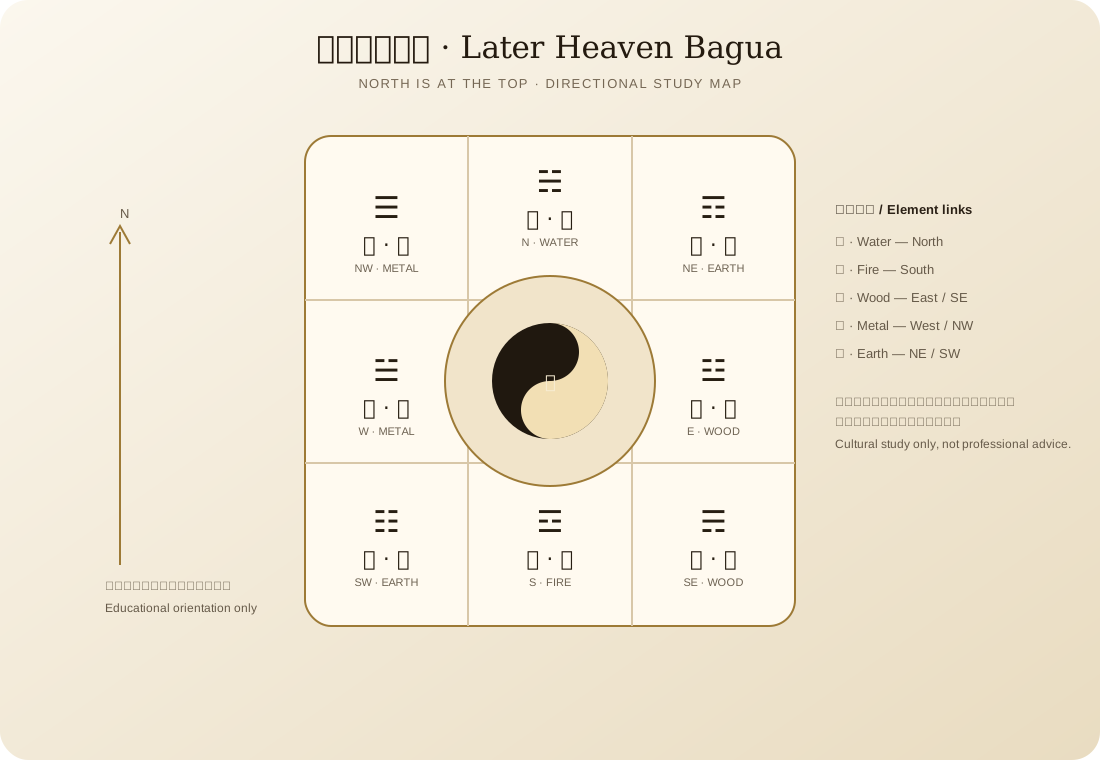
Bagua map elements and direction correspondences
North · Kan · Water
Water symbolism: flow, depth, reflection and rest. In environmental terms, consider cold, moisture, drainage and quiet.
South · Li · Fire
Fire symbolism: light, visibility and warmth. In practice, observe daylight, heat gain, glare and ventilation.
East and Southeast · Zhen / Xun · Wood
Wood symbolism: growth, movement and development. Practical observations include morning light, plants and usable flexible space.
West and Northwest · Dui / Qian · Metal
Metal symbolism: structure, boundaries and refinement. Consider afternoon heat, noise, metal finishes and functional order.
Northeast and Southwest · Gen / Kun · Earth
Earth symbolism: support, transition and containment. Consider stability, storage, floor condition and how spaces connect.
These correspondences are a traditional symbolic language. They do not prove that a particular floor plan will create wealth, illness or relationship outcomes.
For the wider system behind these categories, continue with Five Elements in BaZi and Five Element relationships.
Why different Feng Shui schools disagree
Form School prioritizes visible surroundings such as mountains, waterways and building shape. Compass School readings place much greater weight on exact orientation. Other methods use birth data or fixed floor-plan overlays.
This means a single “directional deity” or object recommendation rarely represents all Feng Shui. Ask which school a method comes from, which data it uses and whether it separates structural advice from symbolic interpretation.
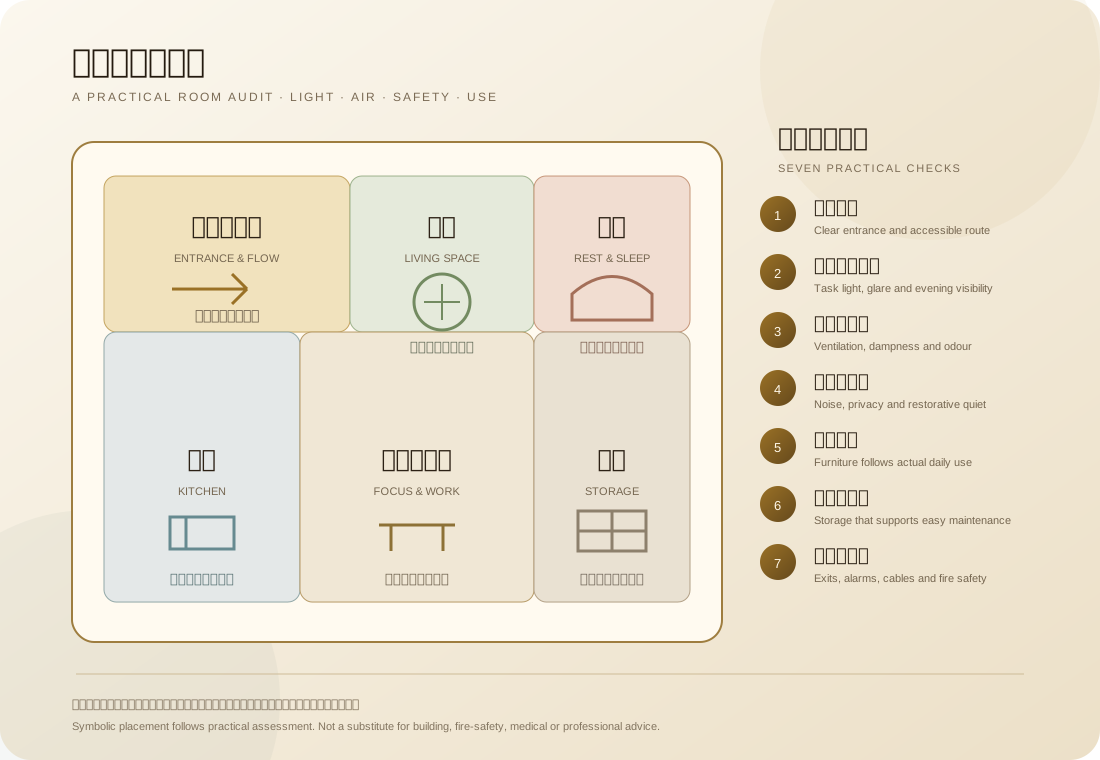
A practical room assessment checklist
- Entrance: Can a person enter safely, see where to go and avoid obstacles?
- Light: Is the room bright enough to use comfortably? Can glare and darkness be controlled?
- Air: Is there adequate ventilation without drafts, dampness or stale air?
- Noise: Does the room support the intended activity, especially sleep and focused work?
- Function: Does the furniture arrangement match how the room is actually used?
- Storage: Can daily objects be put away without blocking movement?
- Safety: Are cables, loose rugs, smoke alarms and exits free from obvious hazards?
If a symbolic change is made, record whether it also improves light, order, comfort or usability. A meaningful improvement is more valuable than collecting objects.
How to conduct a practical room-by-room review
The most useful Feng Shui review starts with the actual room, not an object. Sketch a simple floor plan and mark entrances, windows, daily routes, fixed furniture, damp areas and places where things accumulate. Then observe light, air, sound and use at different times of day.
The priorities change by room. Bedrooms benefit most from quiet, controllable light, ventilation and a clear route to the door. Kitchens require safe extraction, fire awareness, easy cleaning and a workable route between sink, preparation and cooking areas. A home office depends on appropriate light, reduced screen glare and a posture that can be maintained.
Bedroom: rest and safety come first
Check that the route around the bed is clear, night-time movement is safe, curtains control unwanted light, and dampness or odours are addressed. If noise consistently disrupts sleep, improving acoustic separation or repositioning the bed is usually more useful than adding another decorative object.
Living room: support conversation, movement and rest together
Look for conflicts between circulation and furniture, glare on screens, and seats that no longer suit the room's main activities. Symbolic colour choices can be included, but should not reduce accessible routes, child safety or comfortable use.
Kitchen: extraction, fire safety and cleaning matter most
Keep combustible items away from cooking surfaces, maintain working extraction and ventilation, and leave clear space for preparation and cleaning. No directional interpretation should replace gas, electrical or fire-safety checks; potential faults need a qualified professional.
Home office: use light and boundaries to support focus
Position the desk to reduce glare, adjust chair and keyboard height, and keep frequently used materials within reach. If a separate room is not possible, create a functional boundary with a rug, shelving or a consistent work schedule rather than relying on a symbolic remedy.
Objects are symbolic, not automatic fixes
Crystals, mirrors, plants, fountains and figurines have meanings in different traditions. They can also change lighting, space, humidity or safety. There is no universal BaZi or Bagua object that corrects every chart or building.
Be particularly cautious of fear-based shopping advice. A traditional map can provide an interesting cultural lens, but it should not pressure someone to spend money on an object they do not need.
How Feng Shui differs from a Bazi chart
A Bazi chart organizes birth time into Four Pillars and symbolic relationships. Feng Shui studies space, placement and environment. Some advanced traditions combine both, but the tools answer different questions.
Do not assume that a “favorable element” in a Bazi chart automatically means a whole house should be filled with that element. Personal and spatial systems require separate interpretation and practical judgment.
You can continue with Four Pillars foundations, Ten Gods, Five Element relationships or create a free Four Pillars chart.
Explore the symbols, then look at the room
Use Feng Shui as a cultural checklist for spatial awareness: light, airflow, safety and function come before symbolic objects.
Frequently asked questions
Is the Bagua map the same as a compass?
No. The Bagua organizes trigrams and symbolic categories. A compass measures direction. Some methods align the Bagua to compass directions; others use a floor-plan overlay.
Which direction is at the top of the Bagua map?
Conventions vary. This guide places north at the top and labels all directions explicitly to avoid confusion.
Does a Feng Shui object fix a difficult room?
Not automatically. Light, ventilation, safety, noise, storage and building condition matter first. Objects are secondary symbolic additions.
Can Bazi and Feng Shui be combined?
Yes, but carefully. Bazi is a time-based symbol system; Feng Shui examines spatial and environmental relationships. Avoid treating one system as a direct instruction for the other.
What are the Bagua map elements?
Common Later Heaven correspondences are Kan–Water, Li–Fire, Zhen and Xun–Wood, Qian and Dui–Metal, and Gen and Kun–Earth. They are traditional symbolic categories, not scientific guarantees.
Do I need a compass to use a Bagua map?
Not every method uses the same orientation. Some traditions use measured compass directions; others use an entrance-based floor-plan overlay. Know which method you are using before drawing conclusions.
Disclaimer: This guide is for cultural and educational exploration. Feng Shui is not a substitute for engineering, architectural, safety, medical, legal or financial advice.